Last updated: November 4, 2025
Quick Answer
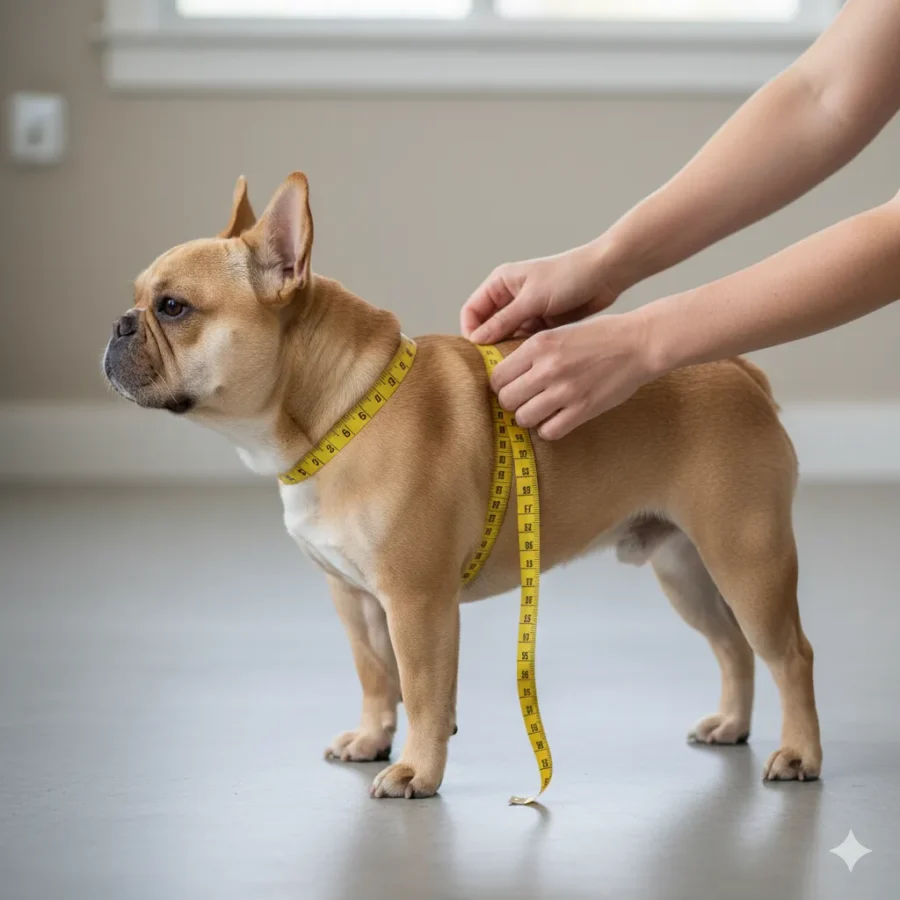
Measure your French Bulldog’s chest girth at the widest part of the ribcage, just behind the front legs. Keep the tape straight and level. Write down the number in inches and centimeters. Compare it to the brand’s size chart. The harness should feel snug but comfortable, without rotating, riding up, or rubbing when the dog moves.
Key Takeaways
- Chest girth sets the size. Neck and side adjusters help fine-tune comfort.
- Measure, don’t guess. Frenchies are compact and barrel-chested. Brand labels vary.
- Try on slowly. Pre-adjust off the dog → put on → walk and turn → micro-adjust.
- Watch for rubbing or rotation. If you can’t fix it, exchange the size or try another style.
- Re-measure as needed. Puppies grow. Layers and weight changes matter.
For health concerns, consult your veterinarian.
Why chest girth matters
French Bulldogs are strong and compact. They have a deep, rounded chest and a short neck. Because of this shape, chest girth is the most reliable number for choosing a harness. A good fit sits flat on the sternum, clears the armpits, and stays centered when the dog turns. Two Frenchies can weigh the same but have different chest shapes. That is normal. This is why measuring comes first, and brand charts come second.
How to measure (simple steps)
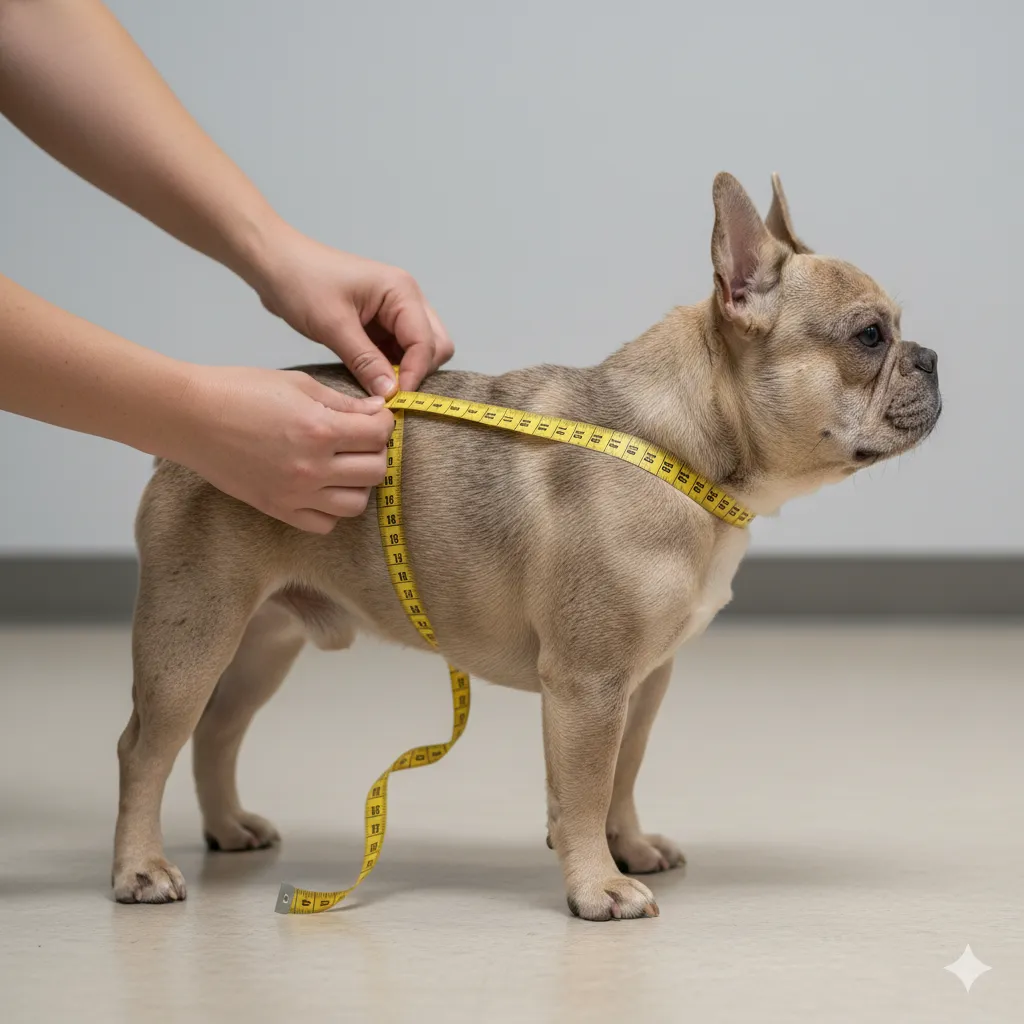
- Stand naturally. Place your dog on level ground in a calm stance.
- Wrap the tape. Put a soft tape around the widest part of the chest, just behind the front legs. Keep the tape level, like a belt.
- Record both units. Write the measurement in inches and centimeters.
- Optional neck check. If the harness adjusts at the neck, measure the base of the neck where a collar would sit.
- Measure twice. Take a second reading. Use the nearest ¼ inch (or 0.5 cm).
- Match the chart. Compare your number to the specific brand and model you plan to buy.
Editor’s tip: If your dog falls between two sizes, look at the adjustment range. If the smaller size still has room to loosen on both sides, try that. If not, choose the larger size and fine-tune.
Harness styles
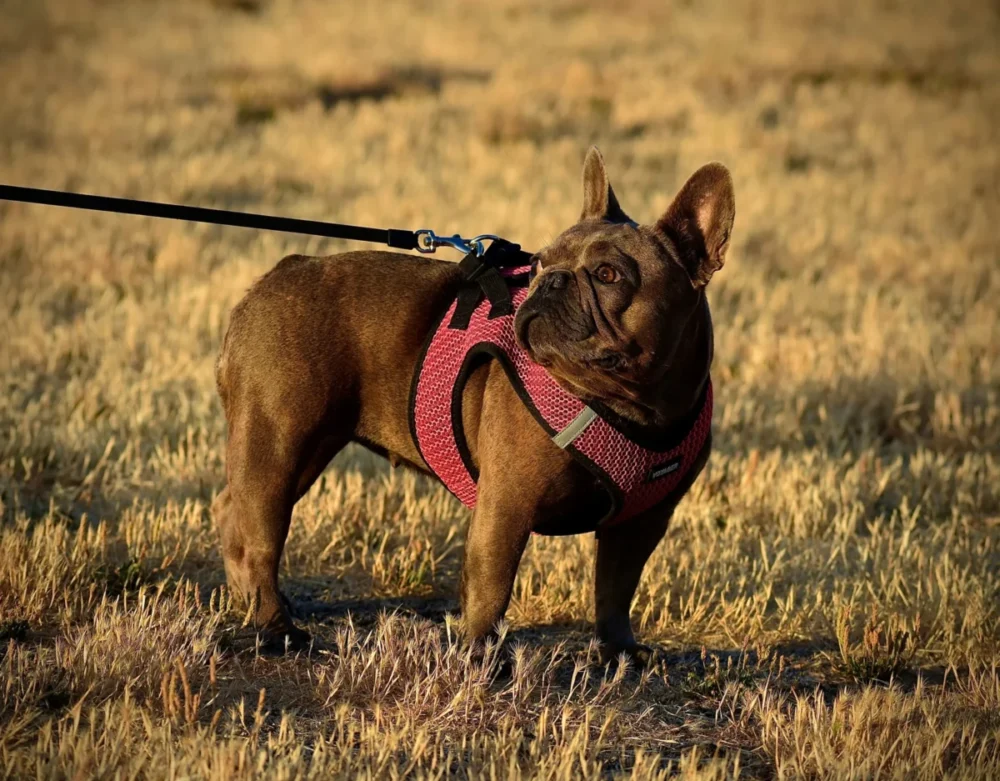
- Y-front / H-style: Two straps meet at the chest to form a “Y.” Often stable and allows shoulder movement. A good everyday choice for many Frenchies.
- Step-in: The dog steps into two openings. It buckles on the back. It is quick to put on, but check that the chest panel does not twist.
- Vest-style: More coverage and padding. It spreads pressure. Make sure the armholes do not rub the armpits.
What to check on any harness:
Number of adjusters (neck, chest, girth), strap width, a sternum plate that lies flat, and where the leash clip sits (back, front, or both). The best harness is the one that fits your dog’s body and stays centered during turns.
Standards Snapshot
Registry language helps explain the Frenchie’s compact build. It does not replace your tape measure. Use it as background only.
| Registry | Accepted wording (size/build) | Why it matters for fit |
|---|---|---|
| AKC | “Weight not to exceed 28 lb”; compact, muscular | More mass on a short frame → chest adjustability is important. |
| FBDCA | AKC-aligned; compact body, deep brisket | Confirms girth placement just behind the front legs. |
| The Kennel Club (UK) | Ideal weights; compact and cobby; balanced | UK phrasing helps global readers set expectations. |
| FCI Standard No. 101 (PDF) | Notes on forechest, proportions, outline | Describes the rounded ribcage that affects tape placement. |
Bottom line: Standards explain the shape. Your measurement decides the size.
Reading chest-girth charts
Brand labels do not match across the market. A “Small” in one brand can overlap an “XS” or a “Medium” in another. Always look at the numbers, not the label.
- Common example bands (for orientation, not rules):
- XS: ~13–17 in / 33–43 cm
- S: ~17–22 in / 43–56 cm
- M: ~22–28 in / 56–71 cm
- Typical Frenchie starting band: Many adult Frenchies measure about 18–22 in (46–56 cm) around the chest. Some are outside this range. This is only a starting point. Always measure and check the brand’s chart for the exact model.
Quick fit check: You should be able to slide one or two fingers under the girth strap without a gap. If the harness rotates off center when your dog turns, even out the adjusters. If it still rotates, try another size or style.
Try-on routine (fast and calm)
- Pre-adjust off the dog. Set the girth strap slightly under the measured number so you have room to loosen.
- Put it on slowly. Avoid twisting straps. Seat the sternum plate flat.
- Walk and turn. Take a short walk. Make a few slow left and right turns. Ask for a sit.
- Micro-adjust. Even out left and right adjustments. Check armpit clearance and clip position.
- Recheck later. Look again after ten minutes and at the next walk. Webbing can settle.
Red flags (non-medical):
Rubbing at the elbows or shoulders, straps digging into the front of the legs, the harness riding up toward the throat, easy backing-out, or constant rotation.
Photo ID Tips (checklist)
Use photos to double-check fit and to make exchanges easier.
- Bright, even light and a plain background
- Camera at mid-chest height (not from above)
- Front view: tape straight and level behind the front legs
- Side view: tape remains level, not angled
- Close-up: sternum plate flat on the chest
- Clearance check: space between strap and armpit
- Movement shot: the harness stays centered during a turn
A note on color marketing
Some harnesses are sold in “rare” shades to match a dog’s coat. Color does not affect sizing or fit. If you want neutral information about how registries describe French Bulldog coat colors, read these resources:
- AKC French Bulldog page
- The Kennel Club (UK) standard
- FCI Standard No. 101
- French Bulldog Club of America
- UC Davis VGL — French Bulldog overview
Stay focused on comfort, adjustability, and build.
Buying and adoption tips (ethics-first)
- Check paperwork. If registration matters to you, confirm the registry and the exact wording on the documents.
- Pick transparency. Favor breeders and rescues who are open about temperament, structure, and daily care—not just color.
- Know the return policy. Even with careful measuring, your first harness might need a swap.
- Save your numbers. Keep chest girth and neck (in & cm) in your phone for faster future shopping.
FAQs
Where should the tape measure go?
Place it around the widest part of the ribcage, just behind the front legs. Keep it level, like a belt.
How tight is correct?
Snug but not pinching. You should slide a finger or two under the girth strap. The harness should not rotate or ride up when the dog turns.
Do most Frenchies small or medium?
Many land in the small-to-medium zone, but labels vary by brand. The number on your tape measure matters more than the size name.
Which style works best?
There is no single best style. Y-front often sits stable and allows movement. Step-in and vest styles can also work if they do not rub and they stay centered.
How often should I re-measure?
Measure monthly for puppies. For adults, re-measure after any weight change, when adding winter layers, or when switching brands.
What if the harness keeps rotating?
Even out the adjusters. Check strap paths and the sternum plate. If rotation continues, change size or style.
Is a front-clip or back-clip better?
Either can be fine if the harness fits well. Some owners prefer back-clip for simplicity; others like a front-clip to help the harness stay centered. Choose what stays stable on your dog.
Does coat color matter for fit?
No. Fit depends on measurements, not color. For neutral information about coat colors, see the resources below.
Sources Used
- American Kennel Club — French Bulldog: https://www.akc.org/dog-breeds/french-bulldog/
- French Bulldog Club of America — Breed Standard: https://frenchbulldogclub.org/the-french-bulldog/breed-standard/
- The Kennel Club (UK) — Breed Standard: https://www.thekennelclub.org.uk/breed-standards/utility/french-bulldog/
- Fédération Cynologique Internationale — Standard No. 101 (PDF): https://www.fci.be/Nomenclature/Standards/101g09-en.pdf
- UC Davis Veterinary Genetics Laboratory — French Bulldog panel overview: https://vgl.ucdavis.edu/panel/french-bulldog
Publisher’s note
This article offers general information to help measure correctly, read brand charts, and fit a harness with care. It avoids medical and training advice and does not make product claims. Measure your dog, study the brand’s chart, and fit the harness slowly. Your dog’s movement will confirm the fit.